
We have collected general purpose technical information here for your reference, including technical notes, presentations and webinars. For product specific technical notes, please see the Technical Support section under the appropriate Product Page.
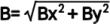
The magnetic field at any point in space is a vector quantity. This means there is a direction associated with the field as well as a field strength. Consider the arrow below: The direction of the arrow can be thought of as the direction of the magnetic field. The length of the arrow can be thought of as the strength of the field, i.e. the longer the arrow, the stronger the field. Call this length B. If I place set of axes on the arrow I can divide the field into two components of the field, namely the x component and the y component. Call these lengths Bx and By. I can now describe the length of the arrow, or the strength of the magnetic field, in terms of the x and y components. Using the Pythagorean Theorem: Now imagine that there exists a third direction, so that the arrow, B can be pointing out of (or into) the plane of the page. There is now a third component, namely Bz, which in our example is the length of the component stretching from the page outward to the tip of the arrow. By exactly the same mathematics, I can now describe B as: The value B, is the strength of the magnetic field. Bx, By, and Bz are the three components measured by a three axis teslameter (gaussmeter). A single axis measuring device will change its reading depending on which way the sensitive axis is oriented with respect to the direction of the magnetic field. To obtain a complete representation of magnetic field at any point in space, one needs not only the value of B, but the direction, which can be expressed as the three components, Bx, By and Bz. Some magnetic field sensors measure only one component of the magnetic field (Fluxgates and Hall effect instruments). These are referred to as single axis devices. Other instruments measure only the total field amplitude (NMR, ESR). This is the quantity B above. It is possible to combine three axis sensors to give three field measurements in a single probe package. These are referred to as three-axis devices. The biological effects of AC fields are detectable at much lower levels than for DC fields. It is therefore inappropriate to use the AC field Guidelines for DC fields. The International Commission on Non-Ionizing Radiation Protection (ICNIRP) Guidelines for Occupational Static Magnetic Fields are 200mT for continuous exposure, 2000mT for short-term whole-body and 5000mT for exposure to arms & legs. These field levels are high and indicate the lack of evidence for biological effects from DC fields. The ICNIRP level for persons with pacemakers and other implanted devices is set at the much lower level 0.5mT (5gauss). This level is apparently not related to biological effects but rather to possible effects on electrical or electronic devices (particularly reed-relays) or metal prosthesis. Adoption of the 0.5mT (5gauss) level and installing shielding or access restrictions avoids potential problems with operators or visitors having implanted devices and also avoids malfunction of most electronic control & test equipment used in the vicinity of magnets. Setting DC Field exposure levels at less than 0.5mT seems unnecessary except for special, magnetically sensitive processes. (Some electron beam equipment such as display devices or electron lithography systems require lower fields.) The US Food and Drug Administration (USFDA) in “Guidance for the Submission of Premarket Notifications for Magnetic Resonance Devices” requires iso-field contours at 0.5mT (5gauss), 1mT, 10mT, 20mT, 40mT, and 200mT (see Section 4, Site Planning) in planes parallel and perpendicular to the magnetic field. Entry into regions where the magnetic field is in excess of 0.5mT is only allowed for authorized personnel. The earth’s geomagnetic field is about 0.05mT (50µT or 0.5gauss). Inside buildings there can be variations due to steel in the building construction. GMW has measured DC fields to about 0.1mT in the open space of buildings and to 0.5mT at the corners of large steel components such as machine tools. In measuring the actual fringing magnetic field it is necessary to remember that the magnetic field (magnetic flux density, B) is a vector quantity with three components. The typical Hall effect Gaussmeter or Teslameter only measures one component of the field. To measure the total field it is necessary to measure the three components Bx, By & Bz and then calculate the vector total (square root of the sum of the squares: Ian J. Walker, August 2000, revised March 2021.




 The three component measurement can be difficult and time consuming with a standard Hall gaussmeter or teslameter. The Metrolab THM 7025 Three Axis Hall Effect Teslameter measures the three components simultaneously & provides the vector total with a resolution down to 0.01mT (0.1gauss). Senis Three Axis Magnetic Field Transducers provide three analog components with a frequency response from dc to approximately 1kHz and can be used with a data logger to map or monitor magnetic fields in the range 0.01mT to 2T. For high resolution measurement or mapping of magnetic fields of less than 1mT, the Bartington Mag-03 range provides very high resolution with frequency response from dc to 3kHz. Acquisition and spectral analysis in a portable instrument is provided by the Bartington Spectramag-6.
For more details, please refer to:
Brookhaven National Laboratory Static Magnetic Field Measurement Principles: Area Surveys